



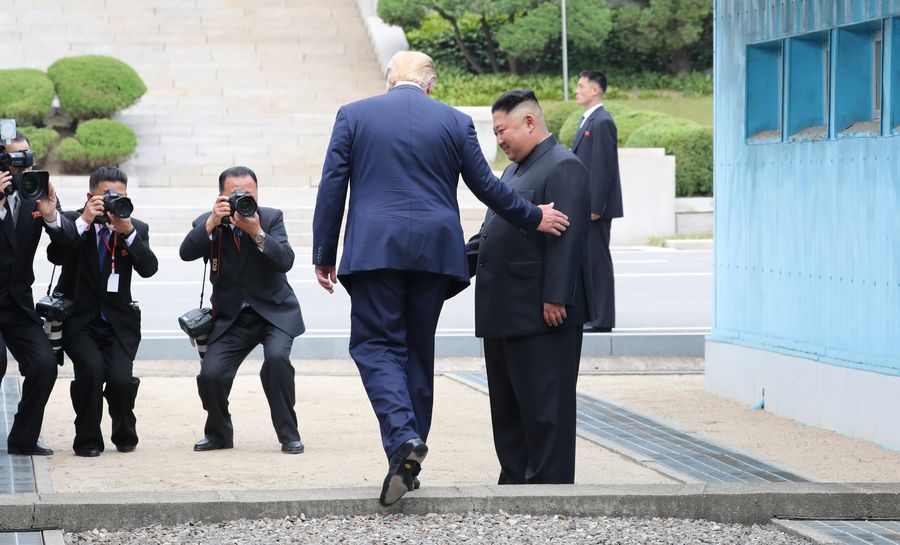
U.S. President Donald Trump crosses the inter-Korean border to become the first sitting U.S. president to step in the Democratic People's Republic of Korea (DPRK) since the end of the 1950-53 Korean War, June 30, 2019. (Xinhua/NEWSIS)
The United States "applied the most brutal and inhuman sanctions against and posed the persistent nuclear threat" to the DPRK over the past seven decades, said Kim Jong Un.
PYONGYANG, Jan. 1 (Xinhua) -- Top leader of the Democratic People's Republic of Korea (DPRK) Kim Jong Un has blamed the United States for the impasse of bilateral nuclear talks, the official Korean Central News Agency reported Wednesday.
At the Fifth Plenary Session of the Seventh Central Committee of the Workers' Party of Korea Tuesday, Kim said the more the United States stalls for time and hesitates in the settlement of the DPRK-U.S. relations, the deeper it will fall into an impasse.
In his report, Kim blamed Washington for the current difficulties facing Pyongyang, saying the United States "applied the most brutal and inhuman sanctions against and posed the persistent nuclear threat" to the DPRK over the past seven decades, and that the current situation on the Korean Peninsula "is getting more dangerous and reaching serious phase."
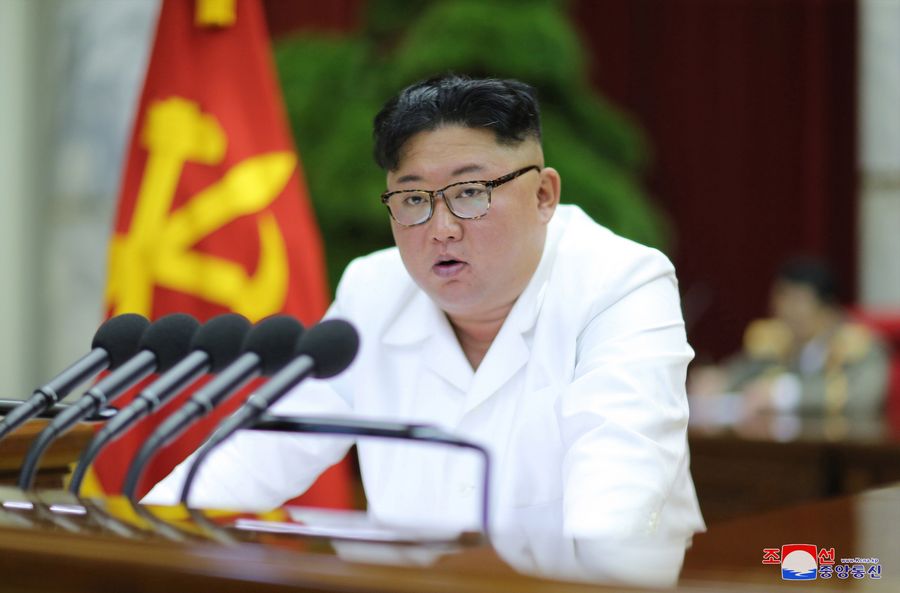
Undated photo handed out by the Korean Central News Agency (KCNA) on Dec. 30, 2019 shows Kim Jong Un, chairman of the Workers' Party of Korea (WPK), addressing the 5th Plenary Meeting of the 7th Central Committee of the WPK in Pyongyang, the Democratic People's Republic of Korea (DPRK). (KCNA/Handout via Xinhua)
Noting that Pyongyang has taken measures to build confidence in bilateral ties, including halting nuclear tests and shutting down a test ground, Kim rebuked Washington for conducting tens of joint military drills and threatening Pyongyang with the shipment of ultra-modern warfare equipment into South Korea.
"There is no ground for us to get unilaterally bound to the commitment any longer," Kim said, adding that "the world will witness a new strategic weapon to be possessed by the DPRK in the near future," without giving details of the weapon.
"If the U.S. persists in its hostile policy towards the DPRK, there will never be the denuclearization on the Korean Peninsula and the DPRK will steadily develop necessary and prerequisite strategic weapons for the security of the state, until the U.S. rolls back its hostile policy towards the DPRK and lasting and durable peace-keeping mechanism is built," he said. ■
