



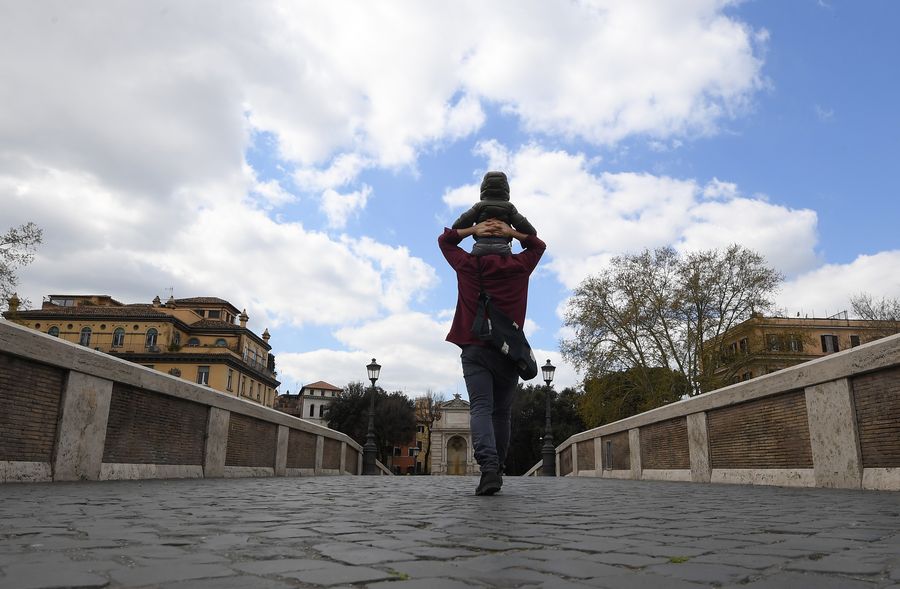
A man walks with his child in Rome, Italy, on April 2, 2020. (Photo by Elisa Lingria/Xinhua)
"Rome and Italy have seen many difficult moments and will be able to overcome even this difficult moment."
By Eric J. Lyman
ROME, April 21 (Xinhua) -- Exactly a year ago, Marco Trevisiani was dressed as a Roman centurion, marching in formation with a small group of similarly costumed soldiers in Circus Maximus, a long park in Rome that in ancient times was the site of a stadium built for chariot races.
The group of re-enactors is part of a gathering each year on April 21, the date when -- according to legend -- Rome was founded, in the year 753 BC.
But this year, Rome's 2,773rd anniversary, everyone will stay at home. It has been exactly six weeks since the country's first national coronavirus quarantine entered into force.
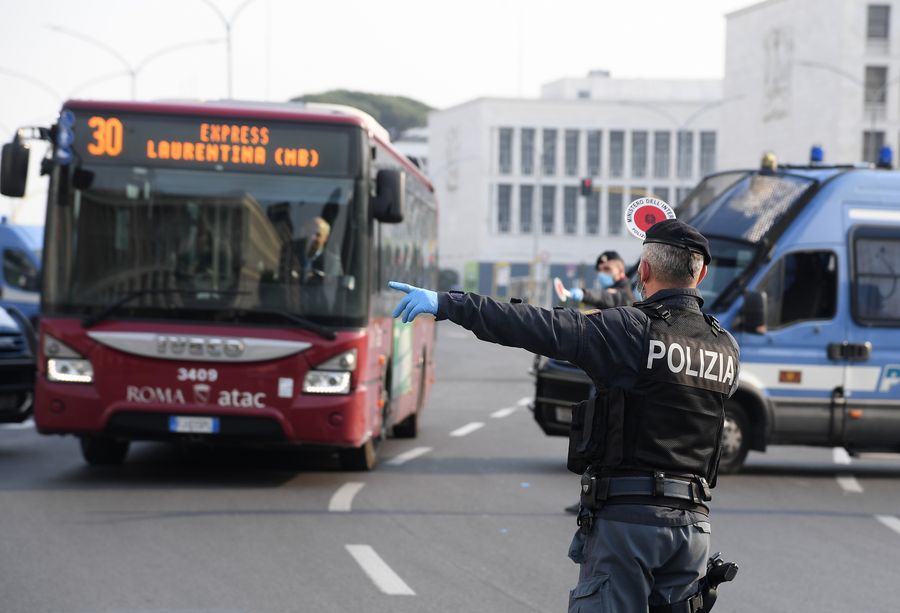
Police officers stop a bus to check in Rome, Italy, on April 13, 2020.(Photo by Augusto Casasoli/Xinhua)
"This year, I think I'll call two of my friends who also play the role of centurions when things are normal," Trevisiani, a Rome native who has temporarily been laid off from his job in a pizzeria, told Xinhua. "I think there will be a commemoration of the anniversary online so I'll probably watch that. It's sad, but we have to do it. Maybe we can make next year's celebration bigger to compensate."
Though the current coronavirus outbreak is the first of its kind experienced by most of the 4.3 million people living in and near the Italian capital, these types of events are not new to the city, according to Maurizio Stefanini.
Stefanini is a native Roman and an author who has written frequently about the various plagues, viral pandemics, and pestilences that have struck Rome over the centuries.

People take exercise on the roof of a building in Rome, Italy, on April 3, 2020. (Photo by Alberto Lingria/Xinhua)
"There were a few big outbreaks that hit the city, starting in the second century and through medieval times, and many dozens of smaller waves of disease, many of which have been lost to history," Stefanini said in an interview. "We think a pandemic was one of the main factors behind the fall of the Roman Empire. These pandemics have been part of human history since the start of time."
Virginia Raggi, mayor of Rome, made a similar point in a special message to the city meant to take the place of the address she would have normally made if Tuesday's celebration had taken place as originally planned.
"Despite everything that is happening, we want to send out a message of hope and courage: together we can pull through," Raggi said. "Rome and Italy have seen many difficult moments and will be able to overcome even this difficult moment."
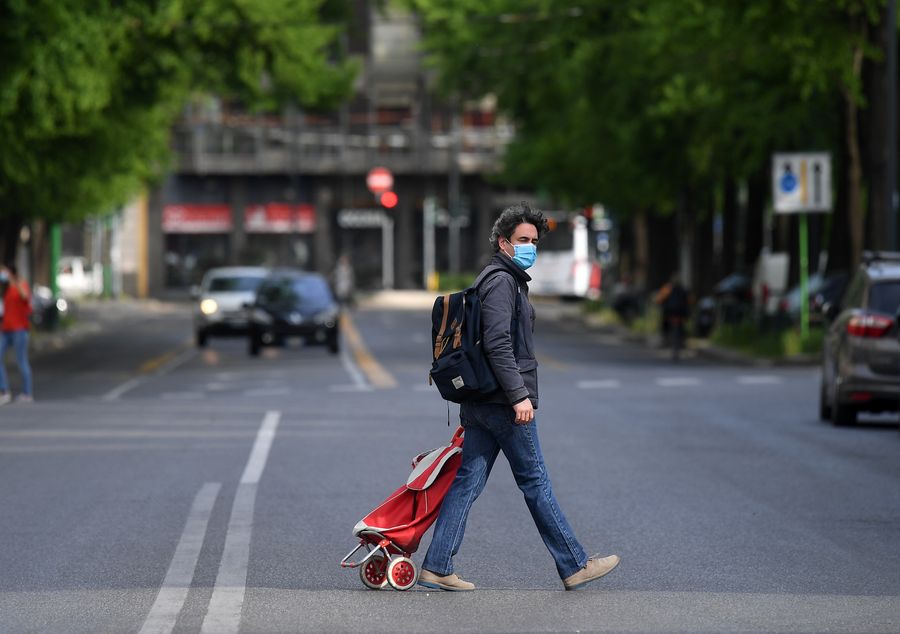
A man wearing a face mask walks on a street in Milan, Italy, on April 18, 2020. (Xinhua)
But the historical context is of only slight comfort to those struggling under the social and economic limits of the lockdown.
"Last year I was guiding a group of tourists on April 21 and we came across the parade celebrating the city's anniversary," Andrea Lillini, a Rome-born tour guide, told Xinhua. "When you are showing visitors around the city you can explain what the city has been through, but talking about some tragedy the city went through is not the same as living through it."
Like Trevisiani, the laid-off pizzeria worker, Lillini said he is worried about how long the lockdown will affect his livelihood.
"When will tourists start to come back to Rome?" Lillini asked. "Will we have work in September or October? Will we have to wait until 2021?"
Trevisiani was philosophical about the question of when he'll go back to work.
"This is not easy, this lockdown is hard on everyone," he said. "But one thing Roman history has taught me is that it is possible to endure hardship and survive." ■
